
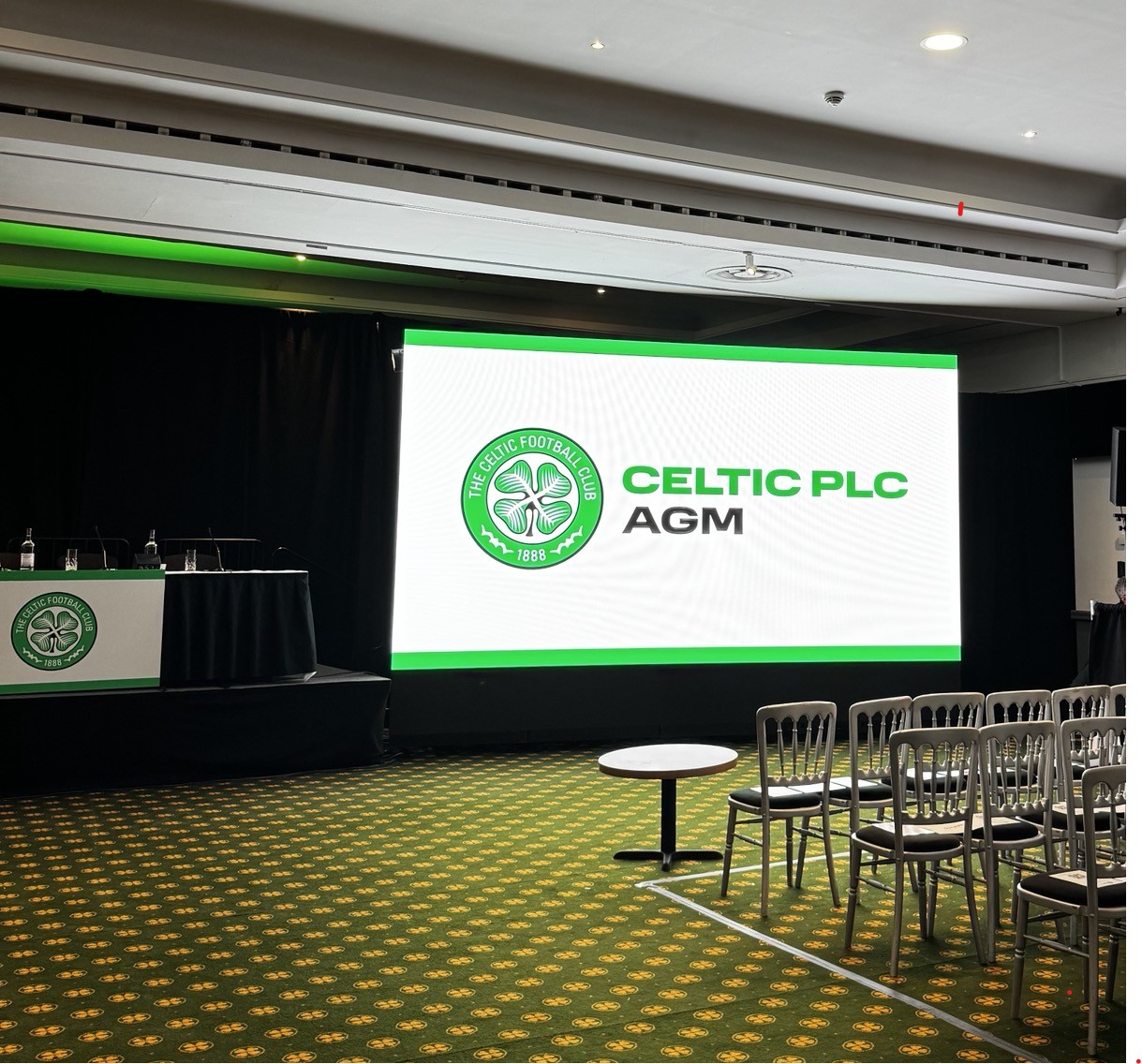
Most of you will know by now that not only is the Celtic plc AGM happening a bit later and on a different day than has been the case for some years, but there will be, this year, a General Meeting to be held in the hours before the Annual General Meeting. The stated reason for this is to consider changes to the Articles of Association which have been in place since 2011. The Articles of Association of a company are really just a written statement of how they run their business in terms of meetings and how the Board makes decisions etc. In the UK they can be read alongside the Companies Act to set out what the Board can do and how they do it.
To revise them every now and again is, no doubt, considered to be good practice and it is refreshing that the Celtic PLC Board have resolved to set before shareholders their proposed revised Articles. Indeed, it would be nice if they applied the same standard to other parts of their Corporate Governance such as the length of time they allow Non-Executive Directors (NEDS) to sit on the Board. In Celtic plc’s case they still have two NEDs (one being the ‘interim’ Chairman) who have served 52 years between them. For context, the UK Corporate Governance Code, recommends a tenure limit for the chair of 9 years and states that NEDs are no longer considered independent after 9 years. Had this been written before the very recent retirement of Peter Lawwell and Tom Allison, the picture would have been very much worse. However, even as it stands, only two of the current set of NEDs has served fewer than 9 years and that includes the recent appointee, Mark Keane who has served zero years! Perhaps they could take the time to address that.
Getting back to the revised Articles of Association. As has been said, revising them from time to time is a good idea but what has motivated them to revise them now. We don’t have to look far for the answer because they have more or less told us. The two key changes which leap out are as follows:
- There will no longer be a show of hands in the room for resolutions
- If the Chairman decides to suspend the meeting, the Board can move it to online without notice.
So lets take them in turn. Throughout most of the Trust’s history we have been the only organisation which has managed to meet the criteria to put a resolution on to the PLC AGM Agenda. To date only two other fan groups have done this – once each. It is hard to underestimate how much the Board hate this. They are absolutely obliged to allow it to happen and, to be fair to them, the person responsible for liaising with us, normally the Company Secretary, is usually fair and reasonable. The fact that on almost every occasion our resolutions are passed in the room (ie by show of hands the majority of shareholders present vote for the resolutions) appears to really annoy them. This is despite the fact that the resolutions are lost because the overwhelming majority of shares voted come from the Board and their allies. Celtic did used to provide us with data on what proportion of shareholders voted for a resolution as well as what proportion of shares were voted for a resolution. After a while they stopped doing that because, it must be assumed, they didn’t want us to use it to show supporters what was going on and to encourage shareholders to use their vote. What they are proposing now is that there will be no record, visible or written, in the public domain which shows that many shareholders vote for our resolutions and that many shareholders vote against their reappointment. There was, a few years ago, two directors whose re-election was lost in the room to such an extent that they were forced to go to a poll and thereby count shareholdings. Embarrassingly for them, one of those was the Chair at the time. What we have then is a Board which commands the overwhelming majority of those shares actually voted but who are so thin-skinned and insecure that they are planning to remove the right of shareholders to show in any public way that they don’t agree with the current Board. It is petty and it is vindictive.
In terms of the other proposed change which relates to online AGMs in certain circumstances. This may seem, to some people like a sensible, modern set up which allows shareholders from all over the world to take part in the Annual General Meeting. However, the clue to the motivation is the wording which stresses the issue of ‘disorder’ or ‘what happened last year’. If the first change was petty and vindictive then this one beats that by a country mile. In order to understand why the suggestion that this is necessary is so egregiously insulting, you would need to understand what actually happened at the 2025 PLC AGM.
- At the start of the meeting, and unlike the normal routine, the Board sneaked onto the stage in darkness. Large numbers of us held up red cards and there was some booing. Nothing was thrown, nothing offensive was said, nobody moved from their seats.
- When the meeting began, and having previously agreed to do this, the Vice-Chair of the Trust, Jeanette Findlay, got up to make a procedural motion – to whit, move next business. The effect of this would have been to skip the PR fluff videos (which anyone can watch on the Celtic website) to give more time for shareholders to ask questions.
- Having got to the one mic available (normally there are several) she found it was switched off. She therefore walked towards to top table in order to be heard. She raised her hand as she walked so that the Chair would realise that she was seeking to be heard.
- The then Chairman, Peter Lawwell, began to mimic her by putting his hand up while, at the same time, staring upwards and refusing to look at her even when she was standing right in front of him. She stated, politely and at a normal volume, that she wished to make a procedural motion and he shouted ‘well you can’t’. After a moment or two, realising he was not going to listen, she returned to her seat. During that time there were audible complaints from shareholders about how she was treated. Having already lost his composure, the Chairman, completely unnecessarily, suspended the meeting for a short time and the Board left the stage. We made repeated requests to Celtic staff during that time that the Company Secretary, who is responsible for the running of the AGM, come to speak to us about where in the Articles of Association it says that a shareholder cannot make a procedural motion. She declined to do so.
- The Board returned to the stage and the videos were duly shown. Many of us chose to wait in the hallway rather than watch them. At the end of the video presentations we came back in to continue with the meeting. Mr Lawwell chose to comment on our return by saying ‘Oh our friends have returned. Look at them. I don’t think many have been to an AGM before, they are only in their 20s’. I will leave you to decide if you think that was an appropriate or dignified thing for a Celtic Chairman (or anyone) to say. We made no response.
- We anticipated that we would now come to the discussion of the resolutions which we planned to contribute to. However, the Chairman then announced that Ross Desmond would say a few words. This is unprecedented in our experience and there was some surprise. As most of you now know, the content of Desmond Junior’s speech was so inflammatory and offensive that it could only have been designed to provoke a reaction. The reaction it got was, in the circumstances, quite muted. Nobody moved from the seated area, nobody threw anything, there was no bad language – all there was were loud groans and shouts that this was out of order or words to that effect.
- Finally, in what now seems either a planned move or an entirely coincidental and comic moment, a man (a Board supporter) who had come and occupied one of the seats at the front while the original occupant was outside in the hallway, stood up and shouted ‘will you shut the fuck up’. At that Mr Lawwell, said ‘That’s it and closed the meeting! He initially forgot to call the poll but stepped back to the mic to call it so that they could subsequently declare that the meeting had been held and there was no need to reconvene. Computershare reps in the hall clearly had not been aware of that because one of them told shareholders that the meeting hadn’t been completed and it would be reconvened.
Many of you will have heard wild and wonderful versions of the meeting from many sources – most of whom were not present – but we unequivocably state here that the rumours of generalised riot and disorder were greatly exaggerated! In truth, it was a relatively mild affair by the standard of shareholder activism at other UK PLCs …or even your average funeral. Anyone who says different must have had a very sheltered upbringing, or they have their own reasons for doing so.
Moreover, the suggestion subsequently shared online that had the meeting continued and questions were asked, that the Board would have been forced to concede that they are, in fact, incompetent. is a nice idea. However, it is not one credibly held by anyone who has, as we have, attended AGMs for over twenty years.
The subsequent public statements from Celtic plc were not surprising in that they sought to divert attention from their complete inability to hold their own AGM in the face of some robust but unexceptional challenges. To then spend a portion of the intervening year designing a way to make sure they don’t have to face any challenge, far less a robust one, is pitiful and shameful.
Had they sought wise counsel it might have been suggested that they use that time to enter into meaningful dialogue with fan organisations and seek to repair the damaged relationship with the support – and in that way cool the temperature of subsequent AGMs. They didn’t. Instead they have introduced changes which give no detail or clarity of the threshold of ‘behaviour’ which might lead to a meeting being moved online. Indeed, our reading of the change leaves us to understand that they can just decide to have it online from the outset if they ‘believe’ that it will be necessary. Who holds them to account for the credibility of that belief? It is certainly not the Nominated Adviser (NOMAD) who we approached last year and who simply referred us back to the Company – who said they had done everything correctly!
So where does that leave us? Well, we must oppose the change in the Articles by attending the General Meeting and/or casting our vote by proxy. You cannot vote change by change because they have chosen to present it as one single document and proposal. It would be good if some of the larger shareholders joined us in seeking to stop the Board embarrassing themselves still further. In the event that they don’t and the changes are made, we can only use whatever other means are open to us to inform the wider fan and shareholder base about the levels of support the Board is able to garner from those of us without the surname Desmond or beholden to someone with the surname Desmond. We are left with a Board of Directors at Celtic PLC who literally fear their own support (not as much as they fear their principal shareholder though) and seek to silence their justifiable criticism in any way they can. They will, in all probability, be able to make this change but it won’t save them from the disdain in which they will be held by anyone looking back on this low point in the history of relations between the supporters and the Board.
No responses yet